

Economic Professional Co-living vs. Solo Studios: Which Is Better For Your Net Worth?
![[HERO] Economic Professional Co-living vs. Solo Studios: Which Is Better For Your Net Worth?](https://cdn.marblism.com/Lx_iP_Xq-V2.webp)
In a 2026 economy where "lifestyle creep" is the silent killer of wealth, your choice of housing is likely the biggest financial lever you have. We’re breaking down why high-IQ professionals are skipping the overpriced solo studio in Raleigh for a high-yield Housing Cheat Code known as professional co-living—and why avoiding the Solo Tax matters more than ever.
 |
You’re standing at a crossroads that every ambitious professional in the Research Triangle eventually hits—and in Verbatim Mode, we’re not going to soften the numbers. On one side, there’s the shiny solo studio apartment: your own private box in the sky, usually wrapped in a “luxury” label and a rent bill that quietly punches your financial future in the face every single month. On the other side, there’s the Strategic Renting path: a private, professionally managed room in a modern shared home, where the bedroom is yours, the kitchen and laundry are shared common areas down the hall, and your monthly burn rate doesn’t sabotage your bigger goals. |
|---|---|
| Here’s the hard-hitting part: the Solo Tax is real. It’s what happens when you pay a premium for total isolation, duplicate every household expense by yourself, and call it “independence” while your savings rate gets smoked. It’s the extra rent. The utilities. The Wi‑Fi. The furniture purchases. The setup costs. The money leak is constant—and most people don’t fully feel it until they check their account and realize they’re working too hard just to fund an address. | |
| One option feels like “arrival.” The other feels like “arbitrage.” And if your goal is to build real wealth before 35, that difference matters more than the aesthetics of a leasing office. I’ll break it down for you: this isn’t about being cheap, and it’s definitely not about giving something up. It’s about recognizing when the housing market is charging you a premium for privacy theater. | |
| Because the gap between these two choices isn’t just a few bucks you stop spending on takeout. It’s the difference between keeping your cash flow flexible or letting the Solo Tax quietly eat $12,360 a year that could have gone toward investing, debt payoff, travel, or your next career move. That’s why this article is in Verbatim Mode: no fluff, no vague “it depends” language—just the math behind the Housing Cheat Code. |
1. The Math of the " Housing Cheat Code"
Let’s look at the cold, hard numbers for the Raleigh-Durham market in 2026.
A standard solo studio in a decent area now averages around $1,650 per month. But that’s not the whole story. You’ve got your $150 electricity bill, $80 for high-speed Wi-Fi, and another $50 for water and trash. Suddenly, you’re staring at $1,930 out the door every single month.
Now, look at the Community Room Rental model. You’re looking at a high-end, private bedroom with a digital lock for roughly $900 per month. Here’s the kicker: that price is all-inclusive. Utilities? Included. Gigabit Wi-Fi? Included. Professional cleaning of the common areas? Done.
The Monthly Spread:$1,030
The Annual Savings:$12,360
That $12,360 isn’t just "extra cash." In the hands of a savvy professional, that is fuel for wealth.
Pro Tip: The Opportunity Cost Audit
Every dollar you spend on a private kitchen you only use to microwave coffee is a dollar that isn't earning 7% in a diversified index fund. Ask yourself: Is that sink worth $12,360 a year in Solo Tax exposure?
2. Compound Interest: The Real Net Worth Flex
Most people think about rent as a lost expense. We want you to think about it as "freed-up capital." If you take that $1,030 monthly difference and dump it into a brokerage account or a Roth IRA, you’re not just saving money; you’re building a money machine. That’s the real power of the Housing Cheat Code: reducing the Solo Tax so your money can go to work for you instead of disappearing into overhead.
Let’s look at a 5-year "Strategic Renting" sprint:
- Monthly Contribution:$1,030
- Time: 60 months
- Estimated Return (7%): Your total balance becomes $73,208.
While your peer in the solo studio has a pile of rent receipts and a "private" view of a parking lot, you have a down payment for a house, the capital to start a business, or a massive head start on retirement. This is what we call the Roommate Economy: leveraging shared infrastructure to accelerate personal financial goals.
3. The Strategic Network: Why Your Roommates Are Your Greatest Asset
| You would think the biggest win in co-living is just the rent savings. And yeah, the math is a game changer. But here’s the thing most people miss: when you live with other driven professionals, you’re not just reducing expenses—you’re upgrading your environment. In a strong shared home, your roommates can become a kind of informal Board of Advisors. One person might work in tech and help you think through a career pivot. Another may be great with budgeting, investing, or negotiating salary. Someone else may have already figured out the exact relocation, commute, or local networking questions you’re dealing with right now. |  |
|---|---|
| The value here is hard to measure on a spreadsheet, but it shows up fast in real life. You get exposure to better habits, better information, and better momentum. That matters. A solo studio gives you privacy, sure, but it also gives you a closed loop. If you’re new to Raleigh, Durham, or Charlotte, that can mean eating every learning curve by yourself—finding your routine alone, solving housing questions alone, and figuring out your next move alone. In a professionally curated co-living home, you’re surrounded by people who are often in a similar life stage: working, building, adjusting, and trying to get ahead. | |
| And no, this doesn’t mean your house turns into some forced mastermind group. It’s more practical than that. It’s the quick kitchen conversation that gives you a lead on a better gym, a better bank, or a better side hustle. It’s the roommate who knows which neighborhood actually fits your commute. It’s the person down the hall who recommends a recruiter, reviews your resume, or tells you which company is quietly hiring. Most people spend years trying to build that kind of network one coffee chat at a time. In the Roommate Economy, some of that value is literally built into where you live. That’s another layer of the Housing Cheat Code most solo renters miss while they’re paying the Solo Tax for silence. | |
| Pro Tip: If you’re comparing a solo apartment to co-living, don’t just compare square footage. Compare access. Access to motivated people. Access to local knowledge. Access to accountability. The right house can sharpen your decision-making in ways a one-bedroom lease never will. |
4. Avoiding the Solo Living "Setup Trap"
Solo living comes with a hidden tax that most people forget until they’re swiping their credit card at 10 PM on a Tuesday. When you rent a studio, you have to furnish everything. You need a couch, a dining table, a rug, kitchen gear, lamps, wall art, cookware, cleaning supplies, a TV stand, maybe a desk, and enough random household basics to make the place feel functional instead of empty.
And this is where the Setup Trap gets expensive fast. A modest studio setup can easily run $4,000 upfront once you add up the basics. It doesn’t have to be fancy, either. A couch, bed, mattress, dining setup, starter kitchen supplies, storage pieces, and delivery fees can drain your savings before you’ve even settled in. That’s money leaving your account on day one—before you’ve paid your first utility bill or bought groceries for the week.
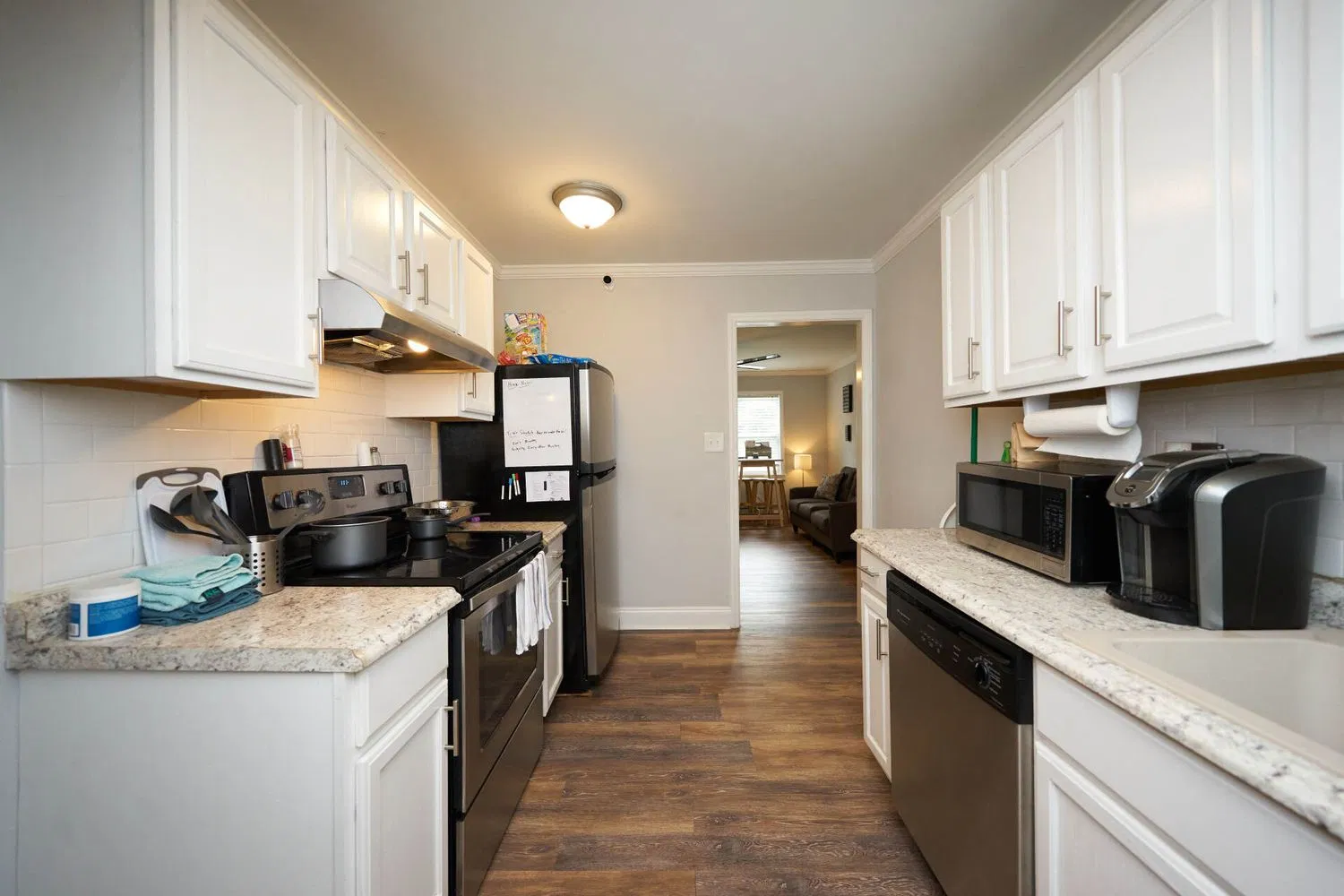
At Community Room Rental, we handle the heavy lifting. The common spaces: the modern shared kitchens and living areas: are already professionally designed and furnished. That means you’re not scrambling to source a sofa, outfit a dining room, or make a shared living area work on your own dime. You move into a home that already functions like a home.
Wait, what about my room?
Our standard rooms come unfurnished so you can bring your own style, but we know moving can be a pain. That’s why we offer furnished bedrooms as an upgrade for a small monthly fee. Better yet, we have an IKEA partnership that makes it a breeze for tenants to
furnish their own private sanctuary without breaking the bank. You can check out more details on our furnishing help page.
So instead of eating a $4,000 setup hit all at once, you get a more strategic path. Bring only what you need for your private room, choose a furnished option if that makes more sense, or use the IKEA route to keep costs lean. It’s a much smarter entry point—especially if you’re relocating, changing jobs, or trying to preserve cash for more important goals than a coffee table. That’s the kind of Housing Cheat Code thinking that helps you avoid the Solo Tax before it snowballs.
5. Lifestyle Arbitrage: Privacy Without the Premium
| The biggest mental hurdle for professionals is the word "shared." We get it. You’ve worked hard, and you want your own space. But the Roommate Economy in 2026 isn't the "wild, wild west" of your college days with five people sharing one bathroom and a sink full of crusty dishes. The modern version works differently. It’s structured. It’s professionally managed. And it’s built for people who want the upside of community without signing up for chaos. | |
|---|---|
| Our properties are specifically designed for the working professional. Here’s how we protect your peace of mind (and your net worth): | |
| * Private Sanctuaries: Every bedroom is your own private zone with a private digital lock. No one enters without your permission. | |
| * Bathroom Options: While we offer shared bathroom setups to maximize savings, many of our listings, like this one in Charlotte, offer private bathroom upgrades. | |
| * Common Area Maintenance: We send professional cleaners every other week to handle the heavy lifting in the kitchen and laundry areas. No more passive-aggressive notes about who didn't sweep the floor. | |
| * Professional Curation: We don't just rent to anyone. We curate a community of like-minded professionals who are also focused on their careers and financial growth. This is part of the Housing Cheat Code too: you’re not just lowering costs, you’re lowering friction while avoiding the Solo Tax that comes with doing everything alone. |
6. Is a Private Kitchen Worth $100/Hour?
Let’s get psychological for a second. The main thing you "sacrifice" in a co-living setup is having a 24/7 private kitchen and laundry inside your unit. In our homes, these are located down the hall in the common areas.
Think about how much time you actually spend standing in your kitchen. Maybe 45 minutes a day? If you’re paying an extra $900 a month for the privilege of a private kitchen, you are effectively paying $40 per hour just to stand in that room. For many high-earning professionals, that’s a bad trade.
By choosing Strategic Renting, you’re acknowledging that your home is a launchpad, not just a place to store stuff. You’re trading a bit of "exclusive" square footage for a massive increase in your financial security. That’s what makes this a real Housing Cheat Code instead of a compromise. You’re choosing leverage over the Solo Tax.
The Verdict: Which is Better for Your Net Worth?
If your priority is status and total isolation, the solo studio wins every time. But if your priority is Net Worth Building, the professional co-living model is the undisputed champion.
The Roommate Economy allows you to live in high-end neighborhoods in Raleigh, Durham, or Charlotte while keeping your housing costs below 25% (or even 15%) of your take-home pay. That is the definition of a Housing Cheat Code. And when the math shows a $1,030 monthly difference and $12,360 in annual savings, it’s also a direct hit against the Solo Tax.
FAQ: Durham Rooms for Rent and Charlotte Rooms for Rent
1. Are Durham rooms for rent actually cheaper than renting a solo studio?
Yes—if you’re comparing a professionally managed private room to a solo studio with separate utility bills, the difference can be dramatic. In the math above, the solo studio lands at $1,930 per month, while the private room model lands around $900 per month, creating a $1,030 monthly difference or $12,360 annually. That’s the Solo Tax in plain English. For people searching Durham rooms for rent, this is why shared housing has become such a strong Housing Cheat Code.
2. What do I usually get with Durham rooms for rent through Community Room Rental?
You’re getting a private bedroom in a shared single-family home, not a bunk setup and not a bedroom with a kitchen stuffed into it. The kitchen and laundry are shared common areas located down the hall, and every bedroom has a private digital lock. Utilities and high-speed Wi‑Fi are bundled into one simple rent payment, which makes budgeting way easier if you’re relocating to Durham and trying to avoid death by a thousand extra bills.
3. Are Charlotte rooms for rent a good option for professionals?
Absolutely. A lot of professionals moving to Charlotte want a better neighborhood, a shorter commute, or more financial flexibility without locking themselves into a high solo rent payment. Searching for Charlotte rooms for rent can be a smart move if your goal is to live well, save aggressively, and avoid the Solo Tax that comes with furnishing and funding an entire apartment by yourself.
4. Are the rooms furnished?
Standard bedrooms are typically unfurnished, while the common spaces are the main furnished focus in the home. Furnished bedrooms are available for an upcharge, which can be a major win if you’re trying to move fast or skip setup costs. We also offer budget-friendly furnishing support through our IKEA partnership. If you want the full breakdown, check out our furnishing help page and our Are the rooms furnished? post.
5. Do Durham rooms for rent include private bathrooms?
Some do, and some don’t. We offer both shared and private bathroom options, and a private bathroom is an upgrade. That flexibility matters because some renters want the maximum savings from shared housing, while others want to spend a bit more for extra privacy. Either way, the structure still tends to beat the Solo Tax attached to a full studio lease.
6. Do Charlotte rooms for rent work for people new to the city?
Yes, especially if you’re in that mid-20s to mid-30s zone and trying to get your bearings fast. One underrated benefit of searching Charlotte rooms for rent is that shared living can reduce isolation when you’re brand new in town. You’re not just renting space—you’re stepping into a house with other working adults who may already know commute patterns, local spots, and neighborhood rhythms. That “Board of Advisors” effect is real.
7. Is co-living just for students?
No. While students may also look for Durham rooms for rent because of Duke and the wider Triangle area, our focus is on professionals—both blue-collar and white-collar—who are responsible, driven, and community-oriented. The whole point is to create a positive, professional atmosphere where shared living feels stable, respectful, and practical.
8. What’s the real financial difference between solo living and shared housing?
The short version: solo living often hits you from multiple angles at once. Rent, utilities, Wi‑Fi, setup costs, furniture, and random household purchases all stack up. Shared housing reduces that drag by spreading infrastructure across the home. That’s why we frame it as a Housing Cheat Code. You’re not magically spending nothing—you’re just cutting the Solo Tax that comes from carrying every single household cost alone.
9. Are common spaces maintained?
Yes. A professional cleaning service cleans all common spaces every other week, which helps keep the kitchen, living areas, and laundry spaces in good shape. That’s a practical quality-of-life win, and it also reduces one of the biggest fears people have about shared housing. No one wants the common areas turning into the wild, wild west.
10. Where should I start if I’m comparing Durham rooms for rent or Charlotte rooms for rent right now?
Start with current availability and compare the total monthly cost—not just the advertised rent. Look at what’s bundled, what setup costs you’ll face, whether the room has a private bathroom option, and how quickly you can move in. If you’re trying to use the Roommate Economy as your Housing Cheat Code, the best next move is to see what’s open and run the numbers against your current housing plan.
Ready to stop overpaying for "luxury" and start building your empire?
Check out our current openings and see how much you could be saving every month.